FoliGrowth Review 2026 - Does This Hair Vitamin Work? is presented for informational purposes by Elmont Drugs. Talk to a pharmacist or your physician before starting any new supplement, device or treatment.
 Hair Multivitamin
FoliGrowth Review: Does This Hair Vitamin Actually Work?
971 reviews
An honest FoliGrowth review: whether the 28-ingredient hair multivitamin works, the important iron caveat, if it's kitchen-sink, how it compares to Nutrafol, and whether it's worth $44.
Published July 6, 2026
Is FoliGrowth worth it? My honest review at a glance
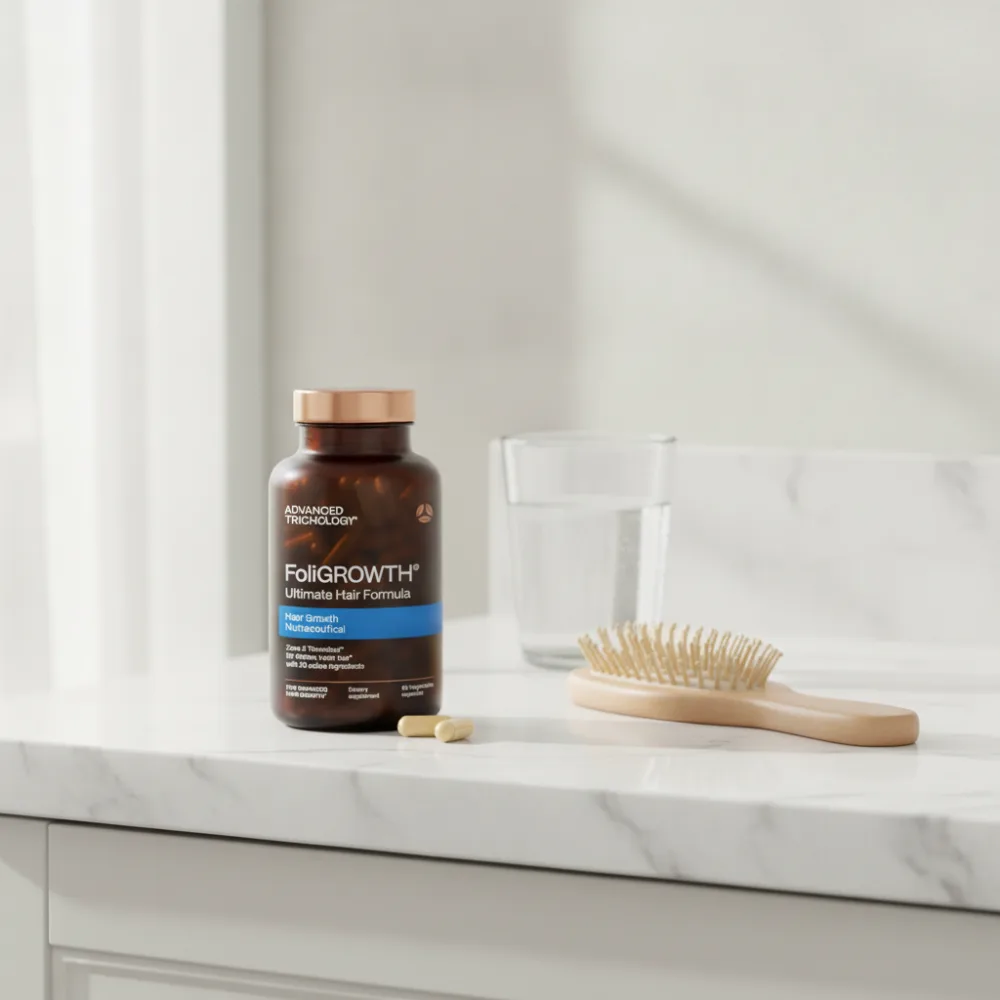
FoliGrowth (FoliGROWTH Ultimate Hair Formula) is a comprehensive 28-ingredient hair multivitamin from Advanced Trichology — the brand founded by real trichologist William Gaunitz — built to "fill the nutritional gaps" behind hair thinning, at about $44. Let me be honest and useful from the first line: this is a sensibly-reasoned, fairly-priced hair supplement. Its core logic is sound — a lot of hair shedding is driven by nutritional deficiencies (low iron, zinc, vitamin D, B12), and FoliGrowth covers those broadly, from a credentialed trichologist, for half the price of Nutrafol. But the honest catches matter: it only helps if your loss is deficiency-driven (genetic/DHT loss won't respond); it contains iron, which is only good for you if you're actually low (you should test first); it's a "kitchen-sink" formula with many thin-evidence extras; and its "76% saw less shedding" stats are an internal survey, not a clinical trial. So the question is: a smart deficiency-filler, or an over-stuffed hair vitamin with an iron you may not need? Let me walk you through it.
I went through whether it works, the iron issue, whether it's kitchen-sink, how it compares to Nutrafol, and whether it's worth $44. Here's my straight take.
A sensible, well-priced hair multivitamin from a real trichologist, built on the sound idea of filling nutritional gaps (iron, zinc, vitamin D) that cause shedding — and it's half the price of Nutrafol. The honest catches: it only helps deficiency-driven loss (not genetic/DHT); it contains iron, which helps only if you're low — test your ferritin first; it's a kitchen-sink 28-ingredient formula with many thin-evidence extras; and its success stats are an internal survey, not an RCT. Reasonable and affordable, with real caveats.
The essentials of my FoliGrowth review
My rating: 5/10 — a sensibly-reasoned, good-value deficiency-filler undercut by an iron-for-everyone approach, kitchen-sink padding, and survey-level claims.
Key spec: 3 capsules daily — 28-ingredient hair multivitamin (includes iron).
| Detail | FoliGrowth (Advanced Trichology) |
|---|---|
| Brand | Advanced Trichology — founded by trichologist William Gaunitz |
| Format | 90 vegetable capsules; 3 daily with meals |
| What's inside | 28 ingredients: iron, zinc, vitamin D, B-complex, biotin, saw palmetto, silica, MSM + more |
| Best for | Deficiency-driven shedding (postpartum, low iron/vitamin D), if you've tested |
| Main knocks | Iron-for-everyone; kitchen-sink; survey (not RCT) claims; modest results |
| Price | $43.95 / ~$37 subscription |
✅ What I liked about FoliGrowth
- ✅ Sound deficiency logic — it covers the nutrients (iron, zinc, vitamin D, B12) that genuinely cause shedding when low.
- ✅ Real trichologist — formulated by Advanced Trichology's William Gaunitz, a credentialed hair specialist.
- ✅ Good value — ~$44, about half the price of Nutrafol.
- ✅ Broad coverage — a genuinely comprehensive vitamin/mineral panel for hair.
❌ What held FoliGrowth back
- ❌ Contains iron for everyone — iron only helps if you're deficient; taking it without a low ferritin is useless and can be harmful.
- ❌ Kitchen-sink formula — many of the 28 ingredients have thin or no hair evidence, and it can double up with your multivitamin.
- ❌ Survey, not RCT — the 76%/75%/86% stats come from a 104-person internal survey, not a controlled trial.
- ❌ Won't fix genetic loss — no vitamin regrows DHT-driven baldness; minoxidil is the proven tool.
Best if your shedding is deficiency-driven — and ideally after you've had your ferritin tested.
In this FoliGrowth review:
- What is FoliGrowth, and what's in it?
- Does FoliGrowth actually work for hair growth?
- Does the iron in FoliGrowth make it right for you?
- Are FoliGrowth's 28 ingredients smart or kitchen-sink?
- Are FoliGrowth's 76% results actually proven?
- Is FoliGrowth worth $44, and how does it compare to Nutrafol?
- Are there side effects to FoliGrowth, and who should skip it?
- Is Advanced Trichology a credible brand behind FoliGrowth?
- My verdict on FoliGrowth
- FoliGrowth FAQ
What is FoliGrowth, and what's in it?
FoliGrowth is a comprehensive daily hair multivitamin — not a single-active supplement, but a broad "fill every gap" formula.

- 🧫 Full vitamin/mineral panel — iron (chelated), zinc, vitamin D3, A, C, E, a complete B-complex (including biotin and folate), plus selenium, iodine, copper.
- 🌿 Hair-specific actives — saw palmetto, L-cysteine, MSM, bamboo silica, hyaluronic acid, keratin support.
- ➕ Botanical extras — Fo-Ti, pine bark, PABA, R-lipoic acid, inositol, choline (the "kitchen-sink" additions).
- 💊 Format — 3 vegetable capsules daily with food; 90 per bottle.
💡 So the philosophy is "cover every possible nutritional cause of hair loss." That's genuinely reasonable for deficiency-driven shedding — but, as you'll see, it also means ingredients you may not need (including iron) and a lot of extras with thin evidence. The scrutiny below is about who it actually helps and the iron question.
Does FoliGrowth actually work for hair growth?
For the right person, yes — but "the right person" is the whole point.
✅ Where it works: if your hair loss is driven by a nutritional deficiency — low iron/ferritin (common postpartum and in menstruating or perimenopausal women), low vitamin D, zinc, or B12 — then correcting that gap can genuinely reduce shedding and restore density. Users report less hair fall within a month and "baby hairs" over a few months. FoliGrowth's deficiency-filling approach is well-suited to this.
⚠️ Where it won't: if your loss is genetic (androgenetic/DHT-driven) — the most common type — no vitamin will regrow it. The proven tools there are minoxidil (and, for men, finasteride). And if you're not deficient at all, a hair vitamin does little.
➡️ So does FoliGrowth work? Yes, for deficiency-driven shedding; no, for genetic hair loss. Give it 3–6 months if you're the right candidate — and the smartest first step is figuring out which type of loss you have (ideally with bloodwork).
Does the iron in FoliGrowth make it right for you?
This is the single most important thing to get right — and where FoliGrowth needs a warning label.
🩸 Iron helps hair only if you're deficient. Low ferritin (iron stores) is a real, common cause of shedding — so for someone who's low, the iron in FoliGrowth is a genuine plus. But if your iron is normal, supplementing it does nothing for your hair and can be harmful: excess iron causes oxidative stress and, over time, can lead to iron overload (a real risk for people who can't clear it, like those with hemochromatosis).
🔬 The honest takeaway: you shouldn't take an iron-containing supplement blindly. A simple ferritin blood test tells you whether you actually need it. If you're low, FoliGrowth's iron is a bonus; if you're not, an iron-free hair formula is the safer choice.
➡️ So the iron is FoliGrowth's best feature for the deficient — and its biggest caveat for everyone else. Test your ferritin first; don't take iron you may not need.
Are FoliGrowth's 28 ingredients smart or kitchen-sink?
A bit of both — a solid core wrapped in padding.
🎯 The smart core: the vitamins and minerals that matter for hair when you're low — iron, zinc, vitamin D, B12, biotin — are all sensibly included. That's the part with real rationale.
🧺 The kitchen-sink part: many of the other extras — Fo-Ti, PABA, pine bark, R-lipoic acid, bamboo silica, MSM — have thin-to-no human evidence for hair. They pad the "28 ingredients" headline more than they add proven benefit. And because it's a full multivitamin, it can double up with a multivitamin you already take — which matters, because too much iron, vitamin A or selenium can actually cause hair shedding. Don't stack it on another multivitamin without checking the overlap.
➡️ So "28 ingredients" is more coverage than proof. The core is sensible; the rest is a reasonable-but-unproven bet. Don't stack it on top of another multivitamin without checking the overlap.
Are FoliGrowth's 76% results actually proven?
Not in the clinical-trial sense.
📊 FoliGrowth's headline stats — "76% reported less shedding in 45 days," "75% stronger hair," "86% improvement" — come from an internal survey of 104 participants, not a placebo-controlled randomized trial. Self-reported satisfaction over 45 days is a real signal of happy customers, but it's not clinical proof. For comparison, Nutrafol has published RCT data; "American Hair Loss Association approved" is a marketing endorsement, not FDA approval or a clinical trial.
➡️ So read the "76%" as customer-satisfaction marketing, not proof that FoliGrowth outperformed a placebo. It doesn't mean the product is bad — it means the evidence bar is survey-level, which is worth knowing before you pay.
Is FoliGrowth worth $44, and how does it compare to Nutrafol?
On value, this is actually FoliGrowth's strong suit.
| Product | Approach | ~Price/mo | Note |
|---|---|---|---|
| FoliGrowth | 28-nutrient deficiency multivitamin (+iron) | ~$44 | Good value; survey claims; contains iron |
| Nutrafol | Saw palmetto, ashwagandha, collagen + more | ~$88 | Published RCTs; pricier; megadose biotin |
| Wellbel Women+ | Saw palmetto + low biotin (menopause) | ~$72 | Menopause-targeted; no iron; leaner |
| Minoxidil (topical) | Minoxidil 2–5% | ~$15–30 | The proven regrowth tool (not a supplement) |
So which makes sense? For a comprehensive deficiency-filling hair vitamin, FoliGrowth is genuinely good value — about half the price of Nutrafol. Nutrafol has published clinical trials (a real evidence edge) but costs twice as much and megadoses biotin; Wellbel is a leaner, menopause-specific option without iron. Honestly, though, the biggest factor isn't the brand — it's the type of loss: minoxidil out-evidences every supplement for genetic thinning. FoliGrowth is a smart-value pick for deficiency-driven shedding, not a substitute for proven treatment.
Are there side effects to FoliGrowth, and who should skip it?
Mostly mild, with the iron caveat front and center.
- 🤢 Iron-related GI effects — iron can cause nausea, stomach upset or constipation (take with food); and again, iron isn't for everyone.
- 💊 How to take it — 3 capsules daily with meals; some report large capsules or an odor.
- ⏳ Timeline — less shedding in ~2–4 weeks; visible fullness at 3–6 months.
- ⚠️ Who should skip it — if your iron is normal (choose iron-free), if your loss is genetic (use minoxidil), or if you already take a multivitamin (avoid doubling up). If pregnant or on medication, check first — see how your pharmacist helps you use supplements safely.
➡️ So FoliGrowth is low-risk for the right person, but the iron makes "the right person" specific: someone who's actually deficient. Test first, and don't stack it on another iron-containing supplement.
Is Advanced Trichology a credible brand behind FoliGrowth?
Yes — and that's a genuine point in its favor.
👨🔬 Advanced Trichology was founded by William Gaunitz, a certified trichologist (a hair-and-scalp specialist) with ~20 years in the field. The brand is focused specifically on hair loss rather than being a generic supplement company, and FoliGrowth reflects a trichologist's "cover the nutritional bases" philosophy. That's more credibility than most hair-vitamin brands offer.
➡️ So the brand is legitimate and hair-specialized — a real reason to trust the intent behind the formula. Just remember: a credentialed founder makes the product credible, not clinically proven — the survey-level evidence and the iron caveat still stand.
My verdict on FoliGrowth — should you buy it?
Is FoliGrowth worth it? My verdict is: a sensible, good-value deficiency-filler with real caveats — 5/10.
Credit where due: FoliGrowth is more thoughtfully reasoned than most hair vitamins. Its core idea — fill the nutritional gaps (iron, zinc, vitamin D, B12) that genuinely cause shedding — is sound, it comes from a real trichologist, it covers the bases broadly, and at ~$44 it's about half the price of Nutrafol. For someone whose thinning is deficiency-driven (postpartum, low ferritin, low vitamin D), it's a reasonable, affordable choice that a share of users genuinely benefit from.
What keeps it at a 5 is fit, formula and evidence. It contains iron, which only helps if you're low — taking it blindly is useless or risky, so you really should test your ferritin first; it's a kitchen-sink formula with many thin-evidence extras that can double up with your multivitamin; its "76%" claims are an internal survey, not an RCT (Nutrafol has published trials); and like all hair supplements, it won't touch genetic loss, where minoxidil is proven.
- 👍 Buy FoliGrowth if your shedding is deficiency-driven (ideally confirmed by bloodwork), you want a comprehensive, well-priced hair vitamin, and you don't already take a multivitamin.
- 👎 Skip it if your iron is normal (choose iron-free), your loss is genetic (use minoxidil), or you want clinically-proven results.
➡️ Bottom line: FoliGrowth is a sensibly-built, trichologist-backed, good-value hair multivitamin whose "fill the gaps" logic is genuinely sound — for the right person. If your shedding is nutritional and you've checked your levels, it's a fair, affordable pick. But the iron makes it a test-first product, the extras are more coverage than proof, and for genetic hair loss a proven treatment like minoxidil matters far more than any vitamin.
Take 3 capsules with food, give it 3–6 months, and check your ferritin before relying on the iron.
FoliGrowth FAQ
Does FoliGrowth actually work?
For deficiency-driven hair loss, yes for many people. If your shedding stems from low iron, zinc, vitamin D or B12, correcting those gaps can genuinely reduce shedding and restore density, and users report less hair fall within a month and baby hairs over a few months. But it won't regrow genetic (DHT-driven) hair loss — minoxidil is the proven tool there. Give it 3–6 months if you're the right candidate.
Do I need to worry about the iron in FoliGrowth?
Yes — this is the key point. Iron only helps hair if you're deficient (low ferritin). If your iron is normal, supplementing it does nothing for your hair and can be harmful, causing oxidative stress or, over time, iron overload. Get a simple ferritin blood test first: if you're low, the iron is a plus; if not, choose an iron-free hair formula.
Is FoliGrowth just a kitchen-sink formula?
Partly. Its core — iron, zinc, vitamin D, B12, biotin — is sensibly chosen for hair when you're low. But many of the 28 ingredients (Fo-Ti, PABA, pine bark, R-lipoic acid, bamboo silica) have thin or no human evidence for hair, padding the "28 ingredients" headline more than adding proven benefit. It's also a full multivitamin, so check it doesn't double up with one you already take.
Are the 76% results proven?
Not clinically. The "76% less shedding," "75% stronger," "86% improvement" stats come from an internal survey of 104 participants, not a placebo-controlled randomized trial. That's a real signal of satisfied customers but not clinical proof, and "American Hair Loss Association approved" is a marketing endorsement, not FDA approval. Nutrafol, by contrast, has published RCT data.
Is FoliGrowth worth it versus Nutrafol?
On value, yes — FoliGrowth is about half the price ($44 vs ~$88). Nutrafol has published clinical trials (a real evidence edge) but costs twice as much and megadoses biotin. FoliGrowth is the better-value comprehensive deficiency-filler; Nutrafol is the more clinically-backed (and pricier) option. For genetic loss, though, neither beats minoxidil.
Are there side effects?
Mostly mild. The iron can cause nausea, stomach upset or constipation, so take it with food — and remember iron isn't for everyone. Some users mention large capsules or an odor. Give any benefit 3–6 months. If you're pregnant, take medication, or already use a multivitamin (to avoid doubling up on iron and fat-soluble vitamins), check with a healthcare professional first.
Who should skip FoliGrowth?
Skip it if your iron/ferritin is normal (choose an iron-free formula), if your hair loss is genetic/DHT-driven (use minoxidil, which is proven), or if you already take a multivitamin and would be doubling up. It's best suited to people with confirmed or likely nutritional deficiencies — postpartum, heavy periods, low vitamin D — ideally after bloodwork.
Keep reading before you buy FoliGrowth
Hair and beauty supplements take different approaches — here's useful context:
- Wellbel Women+ review — a leaner, menopause-targeted hair supplement (no iron).
- YU Nutrition Collagen review — a collagen approach to hair, skin and nails.
- MicroVitamin review — an evidence-based multivitamin (and why it deliberately leaves out iron).
- How your pharmacist helps manage medications and supplements — useful before any new supplement, especially one with iron.
Disclaimer: This FoliGrowth review is independent editorial information, not medical advice. Dietary supplements are not intended to diagnose, treat, cure or prevent any disease. Hair-supplement benefits apply mainly to hair loss driven by nutritional deficiency (e.g., low iron/ferritin, zinc, vitamin D or B12); they do not regrow genetically driven (androgenetic) hair loss, for which topical minoxidil has substantially stronger evidence. This product contains iron: iron supplementation benefits hair only in people who are deficient and can be harmful in those who are not (gastrointestinal effects, oxidative stress, and iron overload in susceptible individuals) — a ferritin blood test is recommended before taking iron, and this product should not be combined with another iron-containing supplement without medical guidance. The manufacturer's efficacy figures (76%/75%/86%) derive from an internal customer survey, not a placebo-controlled clinical trial, and "American Hair Loss Association approved" is not FDA approval. If you are pregnant or breastfeeding, take medication, have hemochromatosis or another iron disorder, or have significant hair loss, consult a licensed healthcare professional (and consider bloodwork to identify treatable causes such as thyroid disease or iron deficiency). This page may contain affiliate links; we may earn a commission at no extra cost to you, which never changes our honest assessment. Pricing and formulation were accurate at the time of writing (July 2026) and may change — verify on the official site.