Love Wellness Bye Bye Bloat Review 2026 - Does It Work? is presented for informational purposes by Elmont Drugs. Talk to a pharmacist or your physician before starting any new supplement, device or treatment.
 Debloat
Love Wellness Bye Bye Bloat Review: Does It Actually Work?
5740 reviews
An honest Love Wellness Bye Bye Bloat review: what the "clinically studied" claim really means, whether it's just a diuretic, the fenugreek safety warning, the price versus rivals, and if Lo Bosworth's debloat pill is worth it.
Published July 3, 2026
Is Love Wellness Bye Bye Bloat worth it? My honest review at a glance
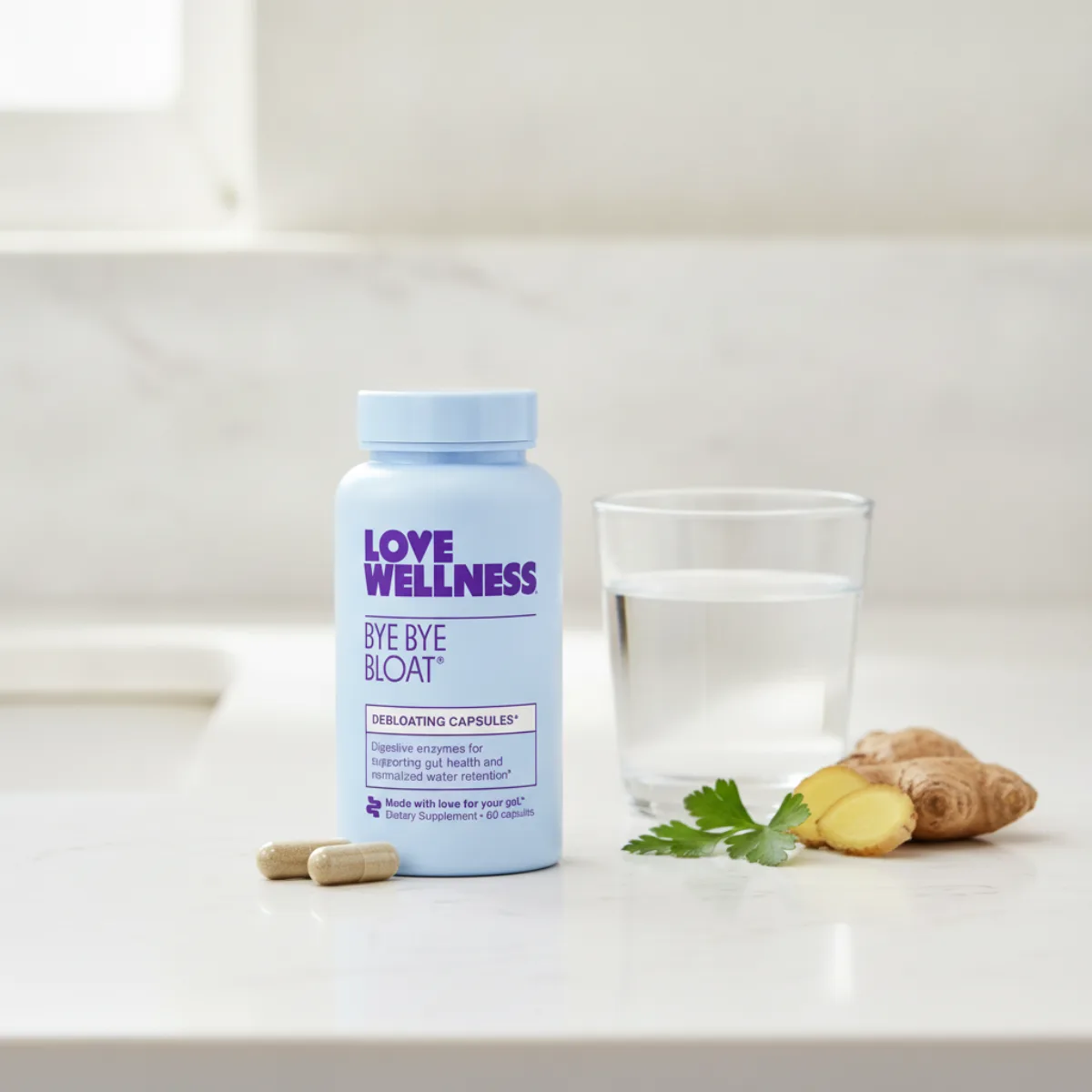
Love Wellness Bye Bye Bloat is the debloat capsule you've seen all over TikTok, Target and Ulta — a $25, celebrity-founded (Lo Bosworth) pill that promises fast relief from meal bloat, gas and premenstrual "puffiness." It's genuinely one of the most affordable and widely-trusted options out there, it's not a harsh laxative, and it has real ingredients (digestive enzymes and ginger) that can ease gas within about an hour. But two things need honest scrutiny: the "clinically studied" badge rests on a weak, brand-funded survey, and a chunk of what it does is simply make you pee out water — which isn't the same as truly debloating (or losing any fat). Let's separate the good value from the marketing.
I dug into the actual clinical study (yes, it's registered — and yes, it's weak), each ingredient's real evidence, a fenugreek safety warning worth knowing, the price versus rivals, and who it's for. Here's my straight, sourced take.
A cheap, widely-available, non-laxative debloat capsule that can ease meal-related gas fast and gently de-puff water retention — genuinely good value (~$0.40 a capsule) from a legit brand. The honest catches: the actives are likely underdosed, the diuretic herbs (dandelion, parsley) cause temporary water loss, not real debloating or fat loss, the "clinically studied" claim is a small, single-arm, self-reported, brand-funded survey (not proof), and the fenugreek carries real interaction cautions. Fair everyday value, oversold as "clinical."
The essentials of my Bye Bye Bloat review
My rating: 6/10 — an affordable, gentle, best-value debloat capsule held back by underdosed actives, a temporary-diuretic mechanism, and an overstated clinical claim.
Key spec: 1-2 capsules as needed — enzymes + ginger, parsley, dandelion, fenugreek.
| Detail | Love Wellness Bye Bye Bloat |
|---|---|
| Brand | Love Wellness (founded by Lo Bosworth; sold at Target, Ulta, CVS, Walmart, Amazon) |
| Format | Capsules — 60 per bottle, 1-2 as needed (max 4/day), around meals |
| Ingredients | Digestive enzyme blend + organic ginger, parsley leaf, fenugreek, dandelion root |
| Targets | Meal/gas bloating, hormonal bloat, water retention |
| Laxative? | No stimulant laxatives (works via enzymes + mild diuretic herbs) |
| Price | $24.99 (~$19.99 on subscription) — about $0.33–0.42 per capsule |
✅ What I liked about Bye Bye Bloat
- ✅ Excellent value — one of the cheapest debloat pills per serving, at 60 capsules for ~$25.
- ✅ Fast, gentle gas relief — enzymes and ginger can ease meal bloat within about an hour, with no laxatives.
- ✅ Legit, widely-available brand — sold in Target, Ulta, CVS and Walmart; ~4.7/5 from thousands of Target reviews.
- ✅ Clean label — gluten-free, dairy-free, organic herbs, no added sugar.
- ✅ Actually registered a study — more transparency than most (even if the study is weak).
❌ What held Bye Bye Bloat back
- ❌ Likely underdosed — the ginger and herbs appear well below the amounts used in research.
- ❌ Mostly a temporary diuretic — dandelion/parsley shed water, which isn't real debloating or fat loss.
- ❌ "Clinically studied" is oversold — the study is small, single-arm, self-reported and brand-funded (no placebo).
- ❌ Fenugreek cautions — interacts with blood thinners and diabetes meds, and is risky with peanut allergy.
💡 It's also on Target/Amazon — and skip it if you take blood thinners or diabetes meds (fenugreek).
In this Love Wellness Bye Bye Bloat review:
- Who makes Bye Bye Bloat, and is the brand legit?
- What's actually inside Bye Bye Bloat?
- Does Bye Bye Bloat actually work, and how fast?
- Is Bye Bye Bloat just a diuretic, and does it cause weight loss?
- Is the Bye Bye Bloat "clinically studied" claim legit?
- How much does Bye Bye Bloat cost, and is it good value?
- How does Bye Bye Bloat compare to other debloat pills?
- Are there side effects to Bye Bye Bloat?
- My verdict on Bye Bye Bloat
- Bye Bye Bloat FAQ
Who makes Bye Bye Bloat, and is the brand legit?
Bye Bye Bloat is the flagship product of Love Wellness, a women's-wellness brand founded by Lo Bosworth (of The Hills). On the legitimacy question, the answer is reassuring: this is a real, well-funded company (it raised over $20M) doing ~$50M in annual revenue, with its products stocked in Target, Ulta, CVS, Walmart and on Amazon, and an advisory board that includes a board-certified OB-GYN. It's not a fly-by-night dropshipping brand.
⚠️ Two honest caveats. First, commercial legitimacy isn't clinical proof — being sold at Target and founded by a celebrity tells you nothing about whether the pill works. Second, Love Wellness is not BBB-accredited, and its recurring complaints center on the subscription (hard to cancel, boxes arriving after cancellation) and misleading "50% off" promos. So: trust the brand's reality and distribution, but buy defensively and judge the product on its ingredients — which is what we'll do next.
What's actually inside Bye Bye Bloat?
Bye Bye Bloat is a blend of digestive enzymes plus four botanicals: organic ginger, parsley leaf, fenugreek and dandelion root. Here's the honest evidence read on each:

- 🫚 Ginger — the best-supported ingredient: real (if modest) evidence for speeding gastric emptying and easing nausea and gas. But research uses ~1000mg; the amount here is likely far lower.
- 💧 Dandelion root + parsley leaf — mild diuretics. They reduce water-retention puffiness by making you urinate, not by fixing digestion (more on this below). Human evidence is thin.
- 🌿 Fenugreek — modest digestion/appetite support, but the ingredient with the most safety caveats (see the side-effects section).
- 🧪 Digestive enzymes — genuinely helpful if your bloating is from heavy meals or malabsorption; useless if it's hormonal, SIBO or IBS-driven.
💡 The honest summary: it's a sensible, gentle combination — enzymes for digestion, ginger for motility, herbs for water — but the doses look modest, and half the formula (the diuretics) tackles puffiness rather than true bloat.
Does Bye Bye Bloat actually work, and how fast?
For the right kind of bloat, it can help — on two different timelines that the marketing blurs together:
- ⚡ Fast (within ~1 hour): for gas and heaviness after a big meal, the enzymes and ginger can bring noticeable relief the same day. This is the win most happy reviewers describe.
- 💧 Within a day or two: the diuretic herbs can reduce premenstrual/water-retention puffiness — but that's temporary water, and it comes back.
- 🗓️ "Lasting" results (2-6 weeks): the brand markets a longer horizon, but there's no strong evidence the formula changes your gut over time; ongoing benefit is really just repeated symptom relief.
⚠️ The fair read: Bye Bye Bloat is a gentle, occasional symptom-reliever — good for meal bloat and mild puffiness, not a fix for chronic or hormonal bloating. It works best taken around a triggering meal, not as a cure. Reviewers with IBS, or whose bloating has a deeper cause, are the ones most likely to say "it did nothing" — because enzymes and a mild diuretic can't address those. Match it to the right problem and it delivers modestly; expect a miracle and you'll be let down.
Is Bye Bye Bloat just a diuretic, and does it cause weight loss?
This is the misconception worth clearing up, because it changes what you should expect.
💧 Part of Bye Bye Bloat is essentially a mild diuretic. Dandelion and parsley increase urination — the one small human study on dandelion (17 women) found more frequent urination over a few hours, though not even a change in total daily urine volume. That can make you feel less "puffy" for a day. But it is water, not fat, and it's temporary — the moment you rehydrate and eat normally, the water returns. (Your body stores 3-4g of water with every gram of glycogen, which is why "water weight" swings so fast.)
➡️ So, does Bye Bye Bloat cause weight loss? No. Any drop on the scale is temporary water weight, not fat loss — and debloating was never meant to be weight loss. If your goal is to feel less bloated and puffy before an event, it can help for a day. If your goal is to lose fat, no debloat pill does that; that takes a sustained calorie deficit. Buy it for comfort, not for the scale.
Is the Bye Bye Bloat "clinically studied" claim legit?
Love Wellness proudly labels Bye Bye Bloat "clinically studied," and cites stats like "80% said their stomach felt more comfortable" and "70% said their clothes fit less tight." Here's the honest breakdown — because this claim is doing a lot of heavy lifting.
✅ To their credit, a study does exist and is registered on ClinicalTrials.gov (NCT06516744) — that's more transparency than most debloat brands offer.
⚠️ But the study is weak evidence, not proof:
- It's a single-group (single-arm) study with no placebo and no control group — so there's nothing to compare against.
- It was open-label and self-reported — roughly 30-40 women simply answered questionnaires on whether they "agreed" they felt better. Self-reported bloating is notoriously prone to the placebo effect.
- It was funded by Love Wellness itself, ran only 4 weeks, and has no peer-reviewed results posted.
➡️ The honest read: a single-arm, un-blinded satisfaction survey measures how people feel, not whether the pill causes the effect. "80% agreed" is real customer sentiment, but it is not clinical proof of efficacy. Take the "clinically studied" badge as a marketing claim built on a soft study — reassuring that they bothered, but not something to buy on.
How much does Bye Bye Bloat cost, and is it good value?
Bye Bye Bloat is $24.99 for 60 capsules (about $19.99 on subscription), which works out to roughly $0.33–0.42 per capsule.
💰 On pure value, this is genuinely a strong point: it's one of the cheapest debloat pills per serving, undercutting HUM Flatter Me, Lemme Debloat and especially Arrae (which runs ~$0.90–1.83 a serving), while offering a full 60-count bottle. For a gentle, occasional-use product, that low per-capsule cost is exactly what you want.
➡️ The value verdict: if you accept it for what it is — a modest, gentle debloat aid — the price is hard to beat. The one caveat is the subscription: buy it one-time (or grab it at Target/Amazon) rather than enrolling in auto-ship, given the cancellation complaints. As affordable everyday relief, it's fair value; just don't overpay by getting stuck in a subscription.
How does Bye Bye Bloat compare to other debloat pills?
Here's how Bye Bye Bloat stacks up against the debloat products people cross-shop, on price and approach.
| Product | ~Price | ~Cost/serving | Approach |
|---|---|---|---|
| Bye Bye Bloat | $24.99 (60ct) | ~$0.33–0.42 | Enzymes + mild diuretic herbs |
| Olly Beat the Bloat | ~$13–18 | ~$0.43–0.72 | Enzymes + dandelion/fennel (drugstore) |
| HUM Flatter Me | ~$33 | ~$0.38–0.55 | 18 digestive enzymes (most enzymes) |
| Lemme Debloat | ~$30 | ~$1.00 | Probiotics + prebiotic (gut-focused) |
So which should you choose? For the cheapest gentle everyday relief, Bye Bye Bloat and Olly are neck-and-neck (Bye Bye Bloat gives you more capsules). For the most digestive enzymes (food-triggered bloat), HUM Flatter Me. For a gut/microbiome approach rather than quick symptom relief, Lemme Debloat. Bye Bye Bloat's edge is price + availability + gentleness; its weakness is that it's lighter on enzymes than HUM and has no probiotics like Lemme. Pick by your bloat's cause, not the celebrity name.
Are there side effects to Bye Bye Bloat?
It's generally gentle, but there are real cautions — especially around fenugreek:
- ⚠️ Fenugreek interactions — it can potentiate blood thinners (bleeding risk) and amplify diabetes/blood-sugar medications (hypoglycemia risk). Don't take Bye Bye Bloat if you're on either without checking with your doctor.
- ⚠️ Peanut allergy — fenugreek is in the legume family and can cross-react; avoid if you have a peanut allergy.
- ⚠️ GI upset — some reviewers report nausea, headache, cramps or diarrhea, particularly those with IBS. Start with one capsule.
- ⚠️ Pregnancy/breastfeeding — fenugreek isn't recommended in pregnancy; check with a professional.
- ℹ️ The Prop 65 warning on the label is a broad California labeling requirement, not evidence the product is dangerous when taken as directed.
If you take medications, it's worth a quick check — see how your pharmacist can review supplement interactions for you.
My verdict on Bye Bye Bloat — should you buy it?
Is Bye Bye Bloat worth it? My verdict is: good, honest value for gentle relief — oversold as "clinical." 6/10.
What it gets right is real: it's one of the cheapest, most widely-available debloat pills, it's gentle and laxative-free, it has legitimately useful ingredients (enzymes and ginger) that can ease meal bloat fast, and it comes from a real, well-distributed brand. For occasional post-meal or premenstrual puffiness, it's a fair, low-cost choice.
What holds it back is the gap between claims and reality: the actives are likely underdosed, half the formula is a temporary diuretic (water, not debloating or fat loss), the "clinically studied" badge rests on a weak self-report survey, and the fenugreek carries genuine interaction cautions. Fair everyday value, dressed up as more than it is.
- 👍 Buy Bye Bye Bloat if you want affordable, gentle, occasional relief from meal bloat or mild puffiness, you'll buy it one-time, and you don't take blood thinners or diabetes meds.
- 👎 Skip it if your bloating is chronic, hormonal, or IBS/SIBO-related (it won't fix those), you're chasing weight loss (it won't do that), you're on interacting meds or have a peanut allergy, or you want the most enzymes or a real microbiome product.
➡️ Bottom line: Bye Bye Bloat is an affordable, gentle, genuinely popular debloat capsule that does a modest job for the right kind of bloat — and is oversold on the "clinical" and implied weight angles. Bought one-time for occasional relief, with realistic expectations and the fenugreek caution in mind, it's decent value. Just know you're buying comfort for a day, not a cure or a diet.
Also at Target and Amazon — buy one-time and skip if you're on blood thinners or diabetes meds.
Bye Bye Bloat FAQ
Does Bye Bye Bloat actually work?
It can ease meal-related gas and bloating within about an hour thanks to enzymes and ginger, and reduce water-retention puffiness for a day or two via mild diuretic herbs. But it's a gentle, occasional symptom-reliever, not a cure — and it does little for chronic, hormonal or IBS bloating. Results vary, and the doses look modest.
Is Bye Bye Bloat just a diuretic?
Partly, yes. The dandelion and parsley act as mild diuretics, so some of the "debloating" is just water loss through more frequent urination. That reduces puffiness temporarily but isn't the same as fixing digestion — and the water comes back once you rehydrate. The enzymes and ginger are the part that actually helps digestion.
Does Bye Bye Bloat cause weight loss?
No. Any quick drop on the scale is temporary water weight from the diuretic herbs, not fat loss. Debloating and weight loss are different things — losing fat requires a sustained calorie deficit, which no debloat pill provides.
Is the "clinically studied" claim legit?
It's real but weak. There's a registered study (NCT06516744), but it's a single-group, open-label, self-reported survey of about 30-40 women over 4 weeks, funded by Love Wellness, with no placebo or control. It measures customer satisfaction, not proven efficacy — so treat "clinically studied" as marketing, not proof.
What are the side effects of Bye Bye Bloat?
Mainly mild GI upset (nausea, cramps, diarrhea), more common in people with IBS. Importantly, the fenugreek can interact with blood thinners and diabetes medications and can cross-react with a peanut allergy — avoid it in those cases, and in pregnancy, without medical advice.
How do you take Bye Bye Bloat?
Take 1-2 capsules around a meal (or before bed), as needed, up to 4 per day. For meal bloat, take it with the triggering meal; for premenstrual puffiness, a daily dose in that window. It works best as targeted relief rather than a constant everyday pill.
Is Bye Bye Bloat worth the money?
For gentle, occasional relief, yes — at ~$0.33–0.42 per capsule it's one of the cheapest debloat pills, and it's sold at Target and Amazon. Just buy it one-time rather than on subscription (the brand has cancellation complaints), and keep expectations modest.
Keep reading before you buy Bye Bye Bloat
A little comparison helps before choosing a debloat product:
- Silver Fern Digestive Enzyme review — a more targeted, higher-dose enzyme if your bloating is food/FODMAP-triggered.
- Happy Mammoth Bloat Banisher review — a pricier enzyme-and-herb debloat capsule with disclosed doses.
- Unbloat review — an all-in-one capsule combining enzymes, probiotics and herbs.
- Bloating Bestie review — a viral debloat pill that (unlike Bye Bye Bloat) hides a stimulant laxative.
Disclaimer: This Love Wellness Bye Bye Bloat review is independent editorial information, not medical advice. Dietary supplements are not intended to diagnose, treat, cure or prevent any disease, and "clinically studied" here refers to a small, single-arm, self-reported, brand-funded study, not proof of efficacy. Debloating is not weight loss; the diuretic herbs reduce water temporarily. Fenugreek can interact with blood thinners and diabetes medications, may cross-react with peanut allergy, and is not recommended in pregnancy. If you are pregnant, breastfeeding, have IBS or another GI condition, or take any medication, consult a licensed healthcare professional before use, and seek medical evaluation for persistent bloating. This page may contain affiliate links; we may earn a commission at no extra cost to you, which never changes our honest assessment. Pricing and formulation were accurate at the time of writing (July 2026) and may change — verify on the official site.