The Nue Co Debloat+ Review 2026 - Worth $55? is presented for informational purposes by Elmont Drugs. Talk to a pharmacist or your physician before starting any new supplement, device or treatment.
 Digestive Enzymes
The Nue Co Debloat+ Review: Does This Enzyme Pill Work?
540 reviews
An honest The Nue Co Debloat+ review: whether the 17 digestive enzymes work for bloating, who it's actually for, if it's just expensive Beano, the truth about the "100%" claims, and whether it's worth $55.
Published July 4, 2026
Is The Nue Co Debloat+ worth it? My honest review at a glance
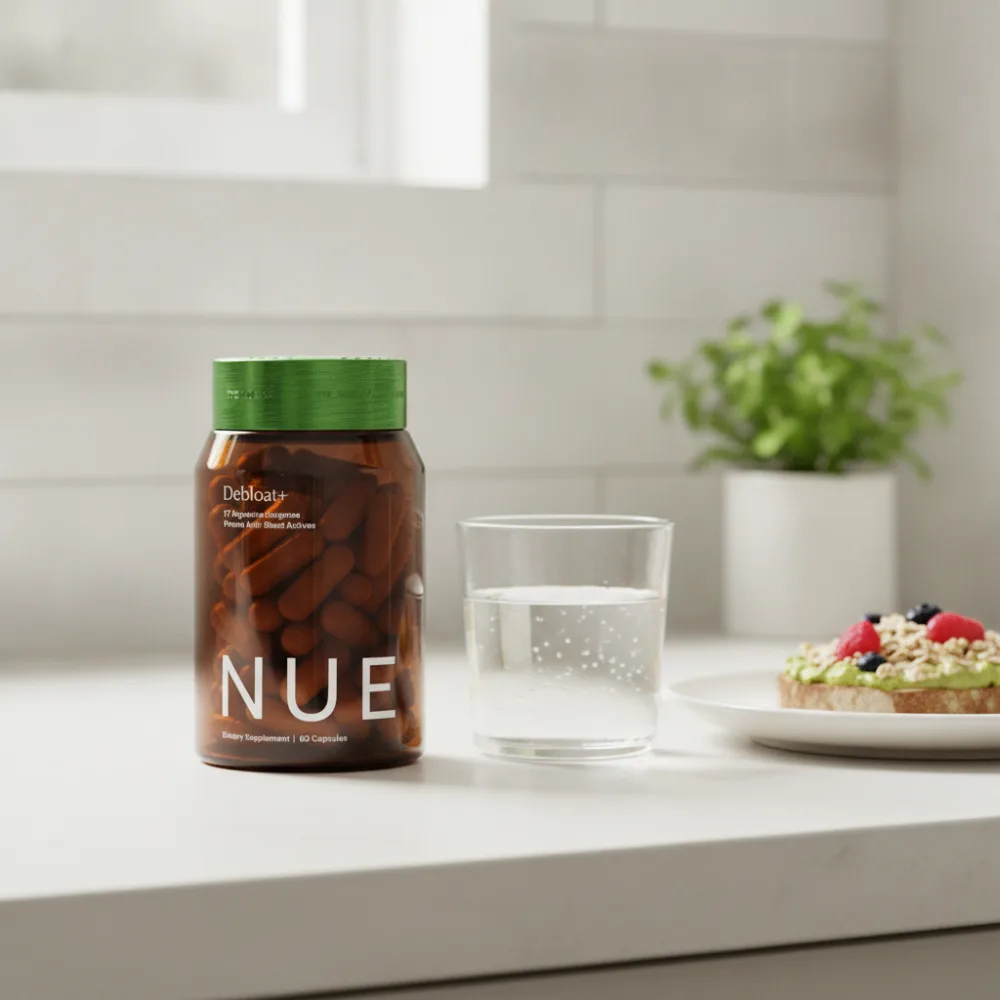
The Nue Co Debloat+ is the premium, clean-wellness bloating capsule you've probably seen on Sephora or Instagram — an amber bottle promising "17 digestive enzymes and proven anti-bloat actives," with a "100% felt a reduction in bloating after one use" headline. Let me be honest and balanced from the first line, because this is a $55 decision: Debloat+ is a legitimate, well-made enzyme-and-herb product from a reputable brand, and for the right kind of bloating it genuinely helps. But it's expensive for what it is, its core mechanism is the same as a $10 generic, and its most impressive stats are in-house or about a single ingredient — not proof of the whole product. Let me walk you through whether it's right for your bloating.
I went through what's actually in it, whether the enzymes work, who it's really for, the "100%" claims, the "isn't this just Beano" question, and whether it's worth $55. Here's my straight, honest take.
A genuine, decently-transparent digestive-enzyme blend (17 enzymes + turmeric, ginger, cinnamon and DGL licorice) from a premium brand — and it does help food-triggered bloating (beans, dairy, cruciferous veg) for many people. The honest catches: enzymes only help bloating caused by digestion (not all bloating), the core enzyme is the same one in $10 Beano, the "100%/90%" figures are in-house surveys (the credible "51%" stat is for the licorice ingredient, not the product), and at $55 with no money-back guarantee it's pricey. Good product, poor value.
The essentials of my Debloat+ review
My rating: 6/10 — a legitimate, reasonably-transparent premium enzyme blend that works for the right bloating, held back by a high price versus identical-mechanism generics.
Key spec: 1–2 capsules with meals — 17 digestive enzymes + carminative herbs.
| Detail | The Nue Co Debloat+ |
|---|---|
| Brand | The Nue Co — premium, clean, B-Corp wellness brand |
| Format | 60 vegan capsules; 1–2 daily with food |
| Actives | A digestive-enzyme blend led by alpha-galactosidase + turmeric, ginger, cinnamon, GutGard DGL licorice |
| Best for | Food-triggered gas/bloating (beans, cruciferous veg, high-FODMAP meals) |
| Main drawback | Price vs identical-mechanism generics; no money-back guarantee |
| Price | $55 one-time ($44 on subscription) |
✅ What I liked about Debloat+
- ✅ Legitimate hero enzyme — alpha-galactosidase genuinely reduces gas from beans and cruciferous veg.
- ✅ Broad, multi-enzyme coverage — a wide enzyme blend for mixed meals, not a single-enzyme product.
- ✅ Reputable, clean brand — vegan, B-Corp, and it isn't a laxative or a "detox" gimmick.
- ✅ Convenient and well-tolerated — a capsule with meals, generally side-effect-free.
❌ What held Debloat+ back
- ❌ Expensive for the mechanism — the same core enzyme as $10 Beano and $27 HUM Flatter Me, and no money-back guarantee.
- ❌ Marketing-y stats and undisclosed doses — "100%/90%" are in-house surveys, the "51%" is for one ingredient, and per-enzyme doses aren't disclosed.
- ❌ Only helps some bloating — enzymes do nothing for fermentation/IBS-type bloating.
Best for food-triggered gas — but a $10–27 enzyme uses the same core mechanism.
In this The Nue Co Debloat+ review:
- What is The Nue Co Debloat+, and what's inside it?
- Does The Nue Co Debloat+ actually work for bloating?
- Who is The Nue Co Debloat+ actually for, and who should skip it?
- Are Debloat+'s "100% and 90%" claims trustworthy?
- Is The Nue Co Debloat+ just expensive Beano?
- How does The Nue Co Debloat+ compare to other debloat pills?
- Is The Nue Co Debloat+ worth $55, or is there a cheaper option?
- How do you take Debloat+, and are there side effects?
- My verdict on The Nue Co Debloat+
- The Nue Co Debloat+ FAQ
What is The Nue Co Debloat+, and what's inside it?
Debloat+ is a digestive-enzyme capsule designed to help you break down the foods that commonly cause gas and bloating, taken with meals. It pairs enzymes with a few soothing herbs.

The formula has two layers:
- 🧬 A digestive-enzyme blend — the workhorses, led by alpha-galactosidase (breaks down the oligosaccharides in beans and cruciferous veg — the same enzyme in Beano), plus amylase, protease, maltase, lipase, bromelain, cellulase, hemicellulase and more for carbs, protein and fat.
- 🌿 Carminative + soothing herbs — turmeric, ginger and cinnamon (traditional anti-gas herbs) and GutGard DGL licorice (a soothing licorice extract).
⚠️ Two honest caveats on the label. First, the "17 digestive enzymes" marketing headline is generous — the actual ingredient list itemizes closer to a dozen (amylase, protease, maltase, alpha-galactosidase, lipase, cellulase, phytase, bromelain, invertase, hemicellulase, glucoamylase). Second, the individual enzyme doses aren't disclosed, so — unlike a plain Beano with a stated alpha-galactosidase amount — you can't verify you're getting a clinically meaningful dose of any single enzyme. Note too there's no clearly-listed lactase, so Debloat+ isn't a reliable pick if dairy is your trigger.
Does The Nue Co Debloat+ actually work for bloating?
For the right kind of bloating, yes — with an honest asterisk.
🔬 The mechanism is real: digestive enzymes work by helping you break down specific foods before gut bacteria ferment them into gas. Alpha-galactosidase — Debloat+'s clearly-listed hero enzyme — has solid randomized-trial evidence for cutting gas from beans and cruciferous vegetables. So for that kind of food-triggered bloating, Debloat+ has a legitimate basis. (One honest caveat: in a trial on IBS patients specifically, alpha-galactosidase wasn't better than placebo — so it's the food trigger, not an IBS label, that predicts whether it helps.)
🗓️ What users report is a clear split: many say "my bloat is gone within an hour" and notice the difference on days they skip it, while others say it did "absolutely nothing." That split is exactly what the science predicts — enzymes help when your bloating is a digestion problem, and do little when it isn't.
⚠️ The honest limit: most everyday bloating comes from gut-bacteria fermentation, IBS, or motility — not an enzyme gap. In those cases, no enzyme (however premium) will fix it. So Debloat+ "works," but only for a specific cause — which makes who you are more important than how good the product is.
Who is The Nue Co Debloat+ actually for, and who should skip it?
This is the section that decides whether your $55 is well spent.
👍 Debloat+ is a good fit if:
- Your bloating is predictable and food-triggered — beans, lentils, broccoli, cabbage or onions/garlic reliably puff you up.
- You get gas and fullness after specific meals rather than constant, unexplained bloating.
- You want a clean, convenient take-with-meals option and don't mind paying for the brand.
👎 You should skip Debloat+ if:
- Your bloating is constant, painful, or unexplained — that points to IBS, SIBO or motility, and needs a doctor, not an enzyme. (For methane/SIBO-type bloating, something like Atrantil has actual study data.)
- Your only trigger is a single food — a targeted, cheaper enzyme fits better (a dedicated lactase like Lactaid for dairy — which Debloat+ doesn't clearly contain — or a fructan enzyme like FODZYME for garlic/onion).
- You're price-sensitive — the same core mechanism costs far less elsewhere.
➡️ In short: Debloat+ is for food-triggered gas, not a cure-all for every puffy belly. Matching it to your actual cause matters more than the brand.
Are Debloat+'s "100% and 90%" claims trustworthy?
The marketing stats are eye-catching, so let's read them honestly.
- 📊 "100% felt a reduction after one use" and "90% feel less bloated after 2 months" — these are in-house consumer surveys: self-reported, subjective, and with no placebo group. They tell you customers felt better, not that the product beat a sugar pill.
- 🔬 The more credible "51% reduction in 30 days" figure comes from a third-party clinical study — but of the GutGard licorice ingredient, not the finished Debloat+ formula. It's a legitimate signal for one component, not proof of the whole product.
➡️ So the numbers aren't fake — they're just weaker evidence than they look. Treat them as "customers tend to like it" plus "one ingredient has some data," not as proof Debloat+ is clinically superior. The honest reason to buy it is the enzyme mechanism, not the headline percentages.
Is The Nue Co Debloat+ just expensive Beano?
It's the question every savvy shopper asks, and it deserves a straight answer.
💡 Partly, yes. Debloat+'s hero enzyme for bean/cruciferous gas — alpha-galactosidase — is the exact same active ingredient in Beano, which costs around $10. For that specific job, the mechanism is identical.
🔀 What the extra money buys: Debloat+ adds a range of other enzymes (so it covers more food types than Beano's single enzyme), plus the carminative herbs and DGL licorice, in a clean, vegan, premium-brand package. That's a real (if modest) difference — a broader net for mixed meals, and a nicer product.
➡️ The takeaway: if your problem is specifically beans and cruciferous veg, Debloat+ is largely "premium Beano" — and Beano wins on value. If you want a broad enzyme blend plus soothing herbs and value the brand, Debloat+ justifies some of its premium — just not all of it.
How does The Nue Co Debloat+ compare to other debloat pills?
The "debloat pill" shelf is crowded in 2026. Here's how Debloat+ sits among the honest options.
| Product | ~Price | Key actives | Note |
|---|---|---|---|
| The Nue Co Debloat+ | $55 | 17 enzymes + turmeric/ginger/DGL | Premium, transparent-ish, broad; pricey |
| HUM Flatter Me | ~$27 | 18 enzymes + ginger/fennel/mint | The closest twin, for half the price |
| Beano (generic alpha-gal) | ~$10 | Alpha-galactosidase only | Same core enzyme for bean/veg gas |
| Arrae Bloat | ~$55 | Carminative herbs + bromelain | Herb-led premium rival; fast-acting |
So which makes sense? If you want the same enzyme approach for less, HUM Flatter Me is the closest twin at roughly half the price. For bean/veg gas only, plain Beano is unbeatable on value. Debloat+ earns its place if you specifically want its broad enzyme-plus-herb blend and the clean premium brand — and if your trigger is actually a FODMAP food like garlic or onion, a targeted enzyme like FODZYME or Silver Fern's FODMAP blend may serve you better than any general enzyme.
Is The Nue Co Debloat+ worth $55, or is there a cheaper option?
On effectiveness, Debloat+ is fine. On value, it's a tough sell.
💰 At $55 for 60 capsules ($44 on subscription), you're paying a real premium for a mechanism you can get for $10–27. And two practical negatives sharpen the point: buyers note there's no money-back guarantee and no multi-bottle discounts, and the value nudge is toward a subscription.
💡 The value verdict:
- Want the enzyme effect cheapest? Beano ($10) or a generic alpha-galactosidase.
- Want a broad enzyme blend at a fair price? HUM Flatter Me (~$27).
- Want Debloat+ specifically for its herbs + clean brand? Buy it — but ideally try a single bottle before subscribing.
➡️ Debloat+ isn't overpriced because it doesn't work — it's overpriced because cheaper products do the same core job. You're paying for formulation, herbs and brand, which is a fine choice to make knowingly, not a value win.
How do you take Debloat+, and are there side effects?
Usage is simple: take it with food so the enzymes are present as you digest the meal — The Nue Co directs 1 capsule twice daily with meals (some users find one capsule with their biggest/trigger meal enough). Because enzymes act meal-by-meal, take it with the food that bothers you, not hours later.
🩺 Side effects: digestive enzymes are generally well tolerated; a minority of users report loose stools or mild GI changes. If you take medication, are pregnant or breastfeeding, or have a medical condition, check with a professional first — and note the DGL licorice, while soothing, is another reason to ask your pharmacist if you're on medication.
My verdict on The Nue Co Debloat+ — should you buy it?
Is The Nue Co Debloat+ worth it? My verdict is: a legit, well-made enzyme pill with poor value — 6/10.
This is one of the honest products in the bloating category. Debloat+ uses a real, targeted hero enzyme (alpha-galactosidase genuinely reduces food-triggered gas), it pairs it with a broad enzyme-and-herb blend, it comes from a reputable clean brand, and it isn't a laxative or a "detox" gimmick. For predictable, food-triggered bloating, it works — and the many "my bloat vanished within an hour" reviews are believable.
What keeps it at a 6 is value and honesty of the pitch: the core mechanism is the same as $10 Beano and $27 HUM Flatter Me, the "100%/90%" stats are in-house surveys (and the credible "51%" is for one ingredient), enzymes only help enzyme-related bloating, and there's no money-back guarantee at a $55 price.
- 👍 Buy Debloat+ if your bloating is clearly food-triggered, you want a broad enzyme-plus-herb blend, and you value the clean premium brand enough to pay for it.
- 👎 Skip it if you want the best value (Beano/HUM), your bloating is constant or painful (see a doctor), or your trigger is a single food better matched by a targeted enzyme.
➡️ Bottom line: The Nue Co Debloat+ is a genuine, quality enzyme supplement that works for the right bloating — you're just paying a premium for a mechanism you can get cheaper. If the brand and the broader blend matter to you, it's a reasonable buy; if value or a specific cause is your priority, a cheaper enzyme, a targeted FODMAP enzyme, or a doctor's visit will serve you better.
A quality enzyme blend — just know a $10–27 option uses the same core mechanism.
The Nue Co Debloat+ FAQ
Does The Nue Co Debloat+ actually work?
For food-triggered bloating, yes — its alpha-galactosidase genuinely reduces gas from beans and cruciferous veg, and many users feel less bloated within an hour. But enzymes only help bloating caused by digestion; for fermentation- or IBS-type bloating, it may do little (alpha-galactosidase wasn't better than placebo in an IBS trial). Results honestly split by cause.
Is The Nue Co Debloat+ just expensive Beano?
Partly. Its hero enzyme for bean/veg gas, alpha-galactosidase, is the same active as $10 Beano. The extra money buys 16 more enzymes (broader food coverage), carminative herbs, DGL licorice and a clean premium brand. For bean/veg gas specifically, Beano wins on value; for a broad blend, Debloat+ adds a little more.
Are the "100%" and "90%" Debloat+ claims real?
They're in-house consumer surveys — self-reported, no placebo group — so they show customers felt better, not that the product beat a sugar pill. The more credible "51% in 30 days" figure is from a clinical study of the GutGard licorice ingredient, not the finished Debloat+ formula. Legit signals, weaker than they look.
Who is The Nue Co Debloat+ best for?
People with predictable, food-triggered gas and bloating — beans, lentils, broccoli, cabbage or onions/garlic. It's less useful for constant, painful or unexplained bloating (which needs a doctor), or for a single-food trigger better matched by a targeted enzyme (a dedicated lactase for dairy, which Debloat+ doesn't clearly contain, or a FODMAP enzyme for garlic/onion).
Is The Nue Co Debloat+ worth $55?
On effectiveness it's fine; on value it's a tough sell, since the same core mechanism costs $10–27 (Beano, HUM Flatter Me). There's also no money-back guarantee. It's worth it only if you specifically want its broad enzyme-plus-herb blend and the clean premium brand — otherwise a cheaper enzyme does the core job.
How do you take Debloat+ and are there side effects?
Take it with food (The Nue Co directs 1 capsule twice daily with meals) so the enzymes are present as you digest — with the food that bothers you, not hours later. Enzymes are generally well tolerated; a minority report loose stools. Check with a professional if you take medication, are pregnant or breastfeeding.
Debloat+ vs HUM Flatter Me — which is better?
They're near-twins: both are broad enzyme blends with carminative herbs. HUM Flatter Me (~$27) offers a similar 18-enzyme approach for roughly half the price, with a small placebo study. Debloat+ adds DGL licorice and a premium clean brand. If value matters, HUM; if you want Debloat+'s specific blend and brand, it's a reasonable step up.
Keep reading before you buy The Nue Co Debloat+
Bloating supplements work in different ways — here's how Debloat+ compares:
- HUM Flatter Me review — the closest enzyme twin, at roughly half the price.
- FODZYME review — a targeted FODMAP enzyme if garlic, onion or wheat are your triggers.
- Hilma Gas + Bloat Relief review — a carminative-herb-only option (no enzymes).
- Atrantil review — a studied option for methane/SIBO bloating that enzymes won't touch.
- How your pharmacist helps manage medications and supplements — useful before adding any supplement.
Disclaimer: This The Nue Co Debloat+ review is independent editorial information, not medical advice. Dietary supplements are not intended to diagnose, treat, cure or prevent any disease. Digestive enzymes reduce bloating only when it is caused by incomplete digestion of specific foods (for example, alpha-galactosidase for beans and cruciferous vegetables, lactase for dairy); they do not address bloating from gut-bacteria fermentation, IBS, SIBO or motility disorders. The manufacturer's "100%" and "90%" figures are self-reported in-house consumer surveys without a placebo control, and the "51% in 30 days" clinical figure refers to the GutGard licorice ingredient, not the finished product. Constant, severe or unexplained bloating, or bloating with pain, weight loss or other red-flag symptoms, warrants medical evaluation. If you are pregnant, breastfeeding, take medication, or have a medical condition, consult a licensed healthcare professional before use. This page may contain affiliate links; we may earn a commission at no extra cost to you, which never changes our honest assessment. Pricing and formulation were accurate at the time of writing (July 2026) and may change — verify on the official site.