Pendulum Akkermansia Review 2026 - Worth $54 a Month? is presented for informational purposes by Elmont Drugs. Talk to a pharmacist or your physician before starting any new supplement, device or treatment.
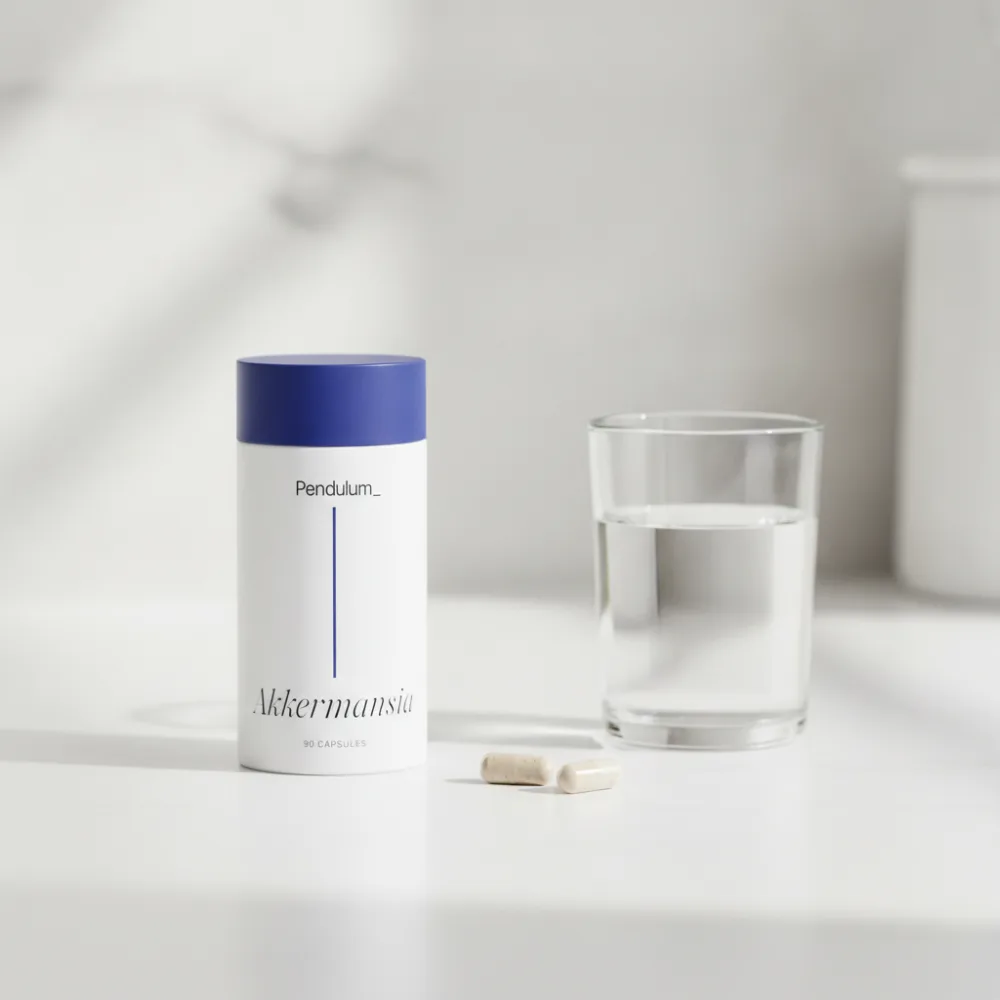 Live Akkermansia
Pendulum Akkermansia Review: Worth It, or Hype?
3000 reviews
An honest Pendulum Akkermansia review: whether the only live Akkermansia probiotic works, if the evidence is RCT or survey, the "natural Ozempic" hype, and whether it's worth $54 a month.
Published July 6, 2026
Is Pendulum Akkermansia worth it? My honest review at a glance
Pendulum Akkermansia is the "keystone strain" probiotic you've probably seen framed as a gut-lining fixer or even a "natural Ozempic" — a single-strain capsule of live Akkermansia muciniphila, at roughly $54 a month. Let me be honest and useful from the first line: this is a genuinely unique, credible product. Pendulum is the only company that grows live Akkermansia (it's notoriously hard to culture), the strain is a real microbiome "keystone" tied to your gut barrier, and the company is science-forward (scientist founders, third-party tested). But the catches are real: the product's headline results come from consumer surveys, not clinical trials; the best human Akkermansia evidence used a different (pasteurized) form; the "GLP-1 / natural Ozempic" angle is hype; and it's expensive for a single strain you have to keep taking. So the honest question is: a legitimately special probiotic, or a premium bet on preliminary science? Let me walk you through it.
I went through whether it works, whether the evidence is real, the "natural Ozempic" claim, and whether it's worth $54 a month. Here's my straight take.
A genuinely unique product — the only live Akkermansia probiotic, a real keystone strain from a credible science brand. The honest catches: its cravings/metabolic claims (77%, 82%, 91%) are consumer surveys, not RCTs; the strongest human Akkermansia data used the pasteurized form (not this live one); the "natural Ozempic" framing is hype (modest ~1–2kg, not semaglutide); it's ~$54/month for one strain; and it's transient (you keep paying to keep the benefit). Special, but preliminary and pricey.
The essentials of my Pendulum Akkermansia review
My rating: 6/10 — a legitimately unique, credible product held back by survey-level evidence, hyped metabolic claims, and a steep single-strain price.
Key spec: capsules daily — single strain, live Akkermansia muciniphila.
| Detail | Pendulum Akkermansia |
|---|---|
| Brand | Pendulum Therapeutics — science-forward microbiome company |
| Format | Capsules; shelf-stable (no refrigeration) |
| What's inside | A single strain: live Akkermansia muciniphila (a keystone gut strain) |
| Best for | Gut-lining and metabolic support, if you value the unique strain |
| Main knocks | Survey-level evidence; GLP-1 hype; price; transient strain |
| Price | ~$54/month subscription (~$84 one-time); FSA/HSA eligible |
✅ What I liked about Pendulum Akkermansia
- ✅ Genuinely unique — the only brand growing live Akkermansia, a hard-to-culture keystone strain.
- ✅ Credible science brand — scientist founders, patented strains, Mayo Clinic registry, third-party tested.
- ✅ Plausible mechanism — Akkermansia strengthens the gut's mucin/barrier layer, with real (if preliminary) metabolic links.
- ✅ Convenient — shelf-stable (no fridge), FSA/HSA eligible.
❌ What held Pendulum Akkermansia back
- ❌ Survey-level proof — the 77/82/91% figures are consumer surveys, not RCTs on this product.
- ❌ "Natural Ozempic" hype — the GLP-1 effect is modest, nowhere near semaglutide.
- ❌ Expensive for one strain — ~$54/month, more than many multi-strain probiotics.
- ❌ Transient — it doesn't colonize permanently, so benefits fade when you stop paying.
A genuinely unique strain — just don't expect Ozempic-level results, and mind the ongoing cost.
In this Pendulum Akkermansia review:
- What is Pendulum Akkermansia, and why is it unique?
- Does Pendulum Akkermansia actually work?
- Is the evidence behind Pendulum Akkermansia RCT or surveys?
- Is Pendulum Akkermansia really a "natural Ozempic" for GLP-1?
- Is Pendulum Akkermansia worth $54 a month for one strain?
- Are there side effects to Pendulum Akkermansia, and does it need refrigeration?
- How does Pendulum Akkermansia compare to Seed and other probiotics?
- Who should buy Pendulum Akkermansia, and who should skip it?
- My verdict on Pendulum Akkermansia
- Pendulum Akkermansia FAQ
What is Pendulum Akkermansia, and why is it unique?
First, an important clarification: this is Pendulum's live Akkermansia probiotic — not its Gut Fuel (a prebiotic fiber, "not the Akkermansia"). This is the real, single-strain Akkermansia product.

- 🦠 A single keystone strain — live Akkermansia muciniphila, one of the most-studied "next-generation" gut bacteria, which feeds and strengthens the gut's mucin (mucus) layer and is linked to gut-barrier and metabolic health.
- 🔬 Pendulum pioneered live Akkermansia — it's an oxygen-sensitive, hard-to-culture anaerobe, and Pendulum was first to grow and stabilize it live from a credible clinical brand. (A few competitors like Codeage now sell live Akkermansia too, so "the only one" is more marketing than fact.)
- 💊 One strain at ~100 million AFU — a modest dose (Pendulum argues Akkermansia is potent at low levels); shelf-stable, no fridge, FSA/HSA eligible.
💡 So this isn't a me-too probiotic: it's a uniquely difficult, differentiated product from a credible company. That uniqueness is real — the honest questions are about how strong the evidence is and whether it's worth the price, which the rest of this review tackles.
Does Pendulum Akkermansia actually work?
Plausibly, for gut and mild metabolic support — with mixed real-world results.
🗓️ What users report: the positive camp describes less bloating, better digestion and regularity, fewer cravings, and more energy, usually building over a few weeks. But there's a real negative camp too: some get stomach pain or notice no change even after prolonged use. As one common line puts it, skeptics wonder if it's "expensive pee."
🔬 Why it plausibly helps: Akkermansia genuinely supports the gut's mucin/barrier layer, and a stronger gut barrier is linked to better digestion and metabolic markers. The mechanism is sound — it's the size and certainty of the human effect (below) that's the question.
➡️ So Pendulum Akkermansia helps a share of users with gut comfort and cravings, backed by a plausible mechanism — give it a few weeks. Just calibrate expectations: this is gentle gut-metabolic support, not a dramatic fix, and it doesn't work for everyone.
Is the evidence behind Pendulum Akkermansia RCT or surveys?
This is the crux, and honesty matters: the product's headline numbers are surveys, and the strongest human proof used a different form.
📊 The 77% / 82% / 91% figures (improved gut health, better regularity, reduced cravings) that Pendulum markets come from consumer surveys of ~80–172 users over 3 months — real satisfaction signals, but with no placebo group and self-reported outcomes. A survey is not a randomized controlled trial.
🔬 The real human science on Akkermansia (the Depommier trial) is genuinely promising for metabolic health — but here's the twist most reviews miss: in that trial, it was the pasteurized (heat-killed) form that improved insulin sensitivity, and the live form did not significantly beat placebo. It also used ~10 billion bacteria a day — roughly 100× the ~100 million AFU dose in Pendulum's capsule. So the strongest evidence arguably supports pasteurized Akkermansia at a much higher dose — not this specific live product.
⚖️ In fairness, Pendulum does have a published human RCT — but on its multi-strain "Glucose Control" product (which lowered A1c modestly), not on this single-strain Akkermansia. Real science, wrong product.
➡️ So credit Pendulum for a plausible, science-backed strain and a credible brand — but read this product's efficacy claims as preliminary (surveys + indirect research at a higher dose/different form), not settled. If you need proven, product-specific results, a synbiotic like Seed (which trials its finished product) has stronger documentation.
Is Pendulum Akkermansia really a "natural Ozempic" for GLP-1?
No — and this is the most oversold claim in the whole category.
💉 Akkermansia can nudge your body's own GLP-1 (the hormone Ozempic mimics), via a protein it makes called P9 — but that GLP-1 mechanism has mainly been shown in mice, not proven in humans. The human metabolic effect is small — something like 1–2 kg over a few months, mostly preventing weight regain, not driving big loss. Semaglutide and tirzepatide directly and powerfully activate GLP-1 receptors — they're in a completely different league.
⚠️ So "natural Ozempic" is a marketing analogy, not a medical equivalence. If you want GLP-1-drug results, a probiotic won't deliver them; if you want gentle metabolic and gut support (and maybe modestly fewer cravings), that's the realistic frame.
➡️ So don't buy Pendulum Akkermansia expecting Ozempic-like weight loss. Buy it (if at all) for its gut-barrier and mild metabolic support — and treat the appetite/cravings benefit as a possible bonus, not a guarantee.
Is Pendulum Akkermansia worth $54 a month for one strain?
It's a genuine premium — justified only if the unique strain is specifically what you want.
💰 At ~$54/month on subscription (or ~$84 one-time), Akkermansia costs as much as (or more than) excellent multi-strain synbiotics — for a single strain. The premium reflects a genuinely hard-to-make product (nobody else grows it live), so it's not a rip-off — but it's undeniably expensive.
⚠️ Two cost realities: the strain is transient (it doesn't permanently colonize, so benefits fade when you stop) — meaning it's effectively an ongoing subscription, not a one-time fix. And cheaper Akkermansia products now exist (e.g., Codeage), though most use the pasteurized form rather than Pendulum's live strain.
➡️ The value verdict: Pendulum Akkermansia is worth it if you specifically want live Akkermansia for gut-barrier/metabolic goals and the ongoing cost fits. If you want broad gut support for the money, a multi-strain synbiotic gives you more organisms and (in Seed's case) product-specific trials for a similar price.
Are there side effects to Pendulum Akkermansia, and does it need refrigeration?
Generally well tolerated, with a few practical notes.
- 💨 Adjustment / GI effects — some users report mild bloating or stomach discomfort early on; a minority get more noticeable stomach pain. Start low and stop if it persists.
- ❄️ No refrigeration needed — Pendulum Akkermansia is shelf-stable, so it survives normal storage and shipping.
- 🔁 Transient strain — benefits last only while you take it; there's no "cure and stop."
- ⚠️ Check first — if you're immunocompromised, pregnant, on a GLP-1 medication, or managing a metabolic condition, talk to a professional — see how your pharmacist helps you use supplements safely.
➡️ So it's low-risk for most, with the usual "ease in and stop if it upsets you" caveat — and no fridge hassle. The bigger "catch" is financial (transient = ongoing), not safety.
How does Pendulum Akkermansia compare to Seed and other probiotics?
It's a different tool than a broad synbiotic — a specialist, not a generalist.
| Product | Approach | ~Price/mo | Note |
|---|---|---|---|
| Pendulum Akkermansia | 1 live keystone strain | ~$54 | Unique strain; survey evidence; metabolic angle |
| Seed DS-01 | 24 strains + prebiotic | ~$50 | Broad; finished-product trials; no Akkermansia |
| Akka Superbiotic | Pasteurized Akkermansia + herbs | ~$50 | Heat-killed strain; "detox" funnel |
| Ritual Synbiotic+ | 2 strains + pre/postbiotic | ~$54 | Transparent 3-in-1; no Akkermansia |
So which makes sense? If you want live Akkermansia from the most clinically-credible brand, Pendulum is the safe pick — but note that Codeage now sells live Akkermansia too, often at a higher AFU dose for less money, so Pendulum isn't your only live option. If you want broad, product-tested gut support, Seed gives you 24 strains and finished-product trials for a similar price. And cheaper "Akkermansia" like Akka is usually the pasteurized form. Pendulum's edge is brand credibility; its weakness is a single-strain premium price.
Who should buy Pendulum Akkermansia, and who should skip it?
This one is genuinely situational.
👍 Pendulum Akkermansia may fit if you:
- Specifically want the live Akkermansia strain for gut-lining or metabolic support and understand the evidence is promising-but-preliminary.
- Are GLP-1-curious (on, considering, or coming off a GLP-1 drug) and want a gentle gut-based add-on — with realistic expectations.
- Can absorb the ongoing ~$54/month cost.
👎 You should skip it if you:
- Want proven, product-specific results — the claims here are survey-level.
- Expect Ozempic-like weight loss — it won't happen.
- Want the most gut support per dollar — a multi-strain synbiotic gives you more for the money.
My verdict on Pendulum Akkermansia — should you buy it?
Is Pendulum Akkermansia worth it? My verdict is: a genuinely unique product on preliminary evidence — 6/10.
Credit where due: this is one of the more legitimately special probiotics you can buy. Pendulum is the only company that grows live Akkermansia — a difficult, patented feat — the strain is a real microbiome keystone with a sound gut-barrier mechanism, and the company is science-forward and credible (scientist founders, Mayo Clinic registry, third-party testing). A share of users genuinely feel less bloated, more regular, and fewer cravings. It's not a gimmick.
What keeps it at a 6 is the gap between the marketing and the proof. Its headline results are consumer surveys, not RCTs; the strongest human Akkermansia evidence used the pasteurized form (not this live one) and was modest; the "natural Ozempic" framing is hype (a small GLP-1 nudge, nothing like the drugs); it's ~$54/month for a single strain; and it's transient, so you pay indefinitely to keep any benefit.
- 👍 Buy Pendulum Akkermansia if you specifically want live Akkermansia for gut-barrier/metabolic goals, you're realistic about the evidence and the GLP-1 angle, and the ongoing cost fits.
- 👎 Skip it if you want proven product-specific results, Ozempic-level weight loss, or the most gut support per dollar — a multi-strain synbiotic is a better all-rounder.
➡️ Bottom line: Pendulum Akkermansia is a genuinely unique, credibly-made probiotic built on promising but still-preliminary science — you're paying a premium for a one-of-a-kind live strain, not a proven metabolic fix. For gut-barrier and gentle metabolic support, and if the price and the "you take it forever" reality are fine, it's a reasonable, science-forward experiment. If you want broad, trial-backed gut support for the money, a multi-strain synbiotic like Seed makes more sense — and either way, ignore the "natural Ozempic" hype.
Unique strain, preliminary evidence — give it a few weeks and keep expectations realistic.
Pendulum Akkermansia FAQ
Does Pendulum Akkermansia actually work?
Plausibly, for gut comfort and mild metabolic support. Users report less bloating, better regularity and fewer cravings over a few weeks, and the strain has a sound gut-barrier mechanism. But results are mixed (some notice nothing, a few get stomach pain), and the product's efficacy claims come from surveys, not clinical trials. Expect gentle support, not a dramatic fix.
Is the evidence real, or just surveys?
Both, with a caveat. The 77/82/91% figures Pendulum cites are consumer surveys (no placebo, self-reported). The genuine human science on Akkermansia is promising for metabolic health, but it largely used the pasteurized (heat-killed) form, not this live strain, and effects were modest. So the evidence supports Akkermansia the ingredient more than it proves this specific live product.
Is Pendulum Akkermansia a "natural Ozempic"?
No. Akkermansia can slightly nudge your own GLP-1 (the hormone Ozempic mimics), but the effect is small — roughly 1–2 kg over months, mostly preventing weight regain. Semaglutide and tirzepatide directly and powerfully activate GLP-1 receptors and are in a completely different league. "Natural Ozempic" is a marketing analogy, not a medical equivalence.
Is it worth $54 a month for one strain?
Only if you specifically want live Akkermansia. It costs as much as excellent multi-strain synbiotics for a single strain — justified by how hard it is to make (nobody else grows it live), but undeniably expensive. It's also transient, so benefits fade when you stop, making it an ongoing cost. For broad gut support per dollar, a multi-strain product gives you more.
Does Pendulum Akkermansia need refrigeration?
No — it's shelf-stable, so it survives normal storage and summer shipping without a fridge. That's a genuine convenience, since some live probiotics do require refrigeration. Just store it in a cool, dry place out of direct heat like any supplement.
Are there side effects?
It's generally well tolerated. Some users report mild bloating or stomach discomfort early on as their gut adjusts, and a minority notice more stomach pain — ease in and stop if it persists. If you're immunocompromised, pregnant, on a GLP-1 medication, or managing a metabolic condition, check with a healthcare professional first.
How is this different from Pendulum Gut Fuel or Akka?
Pendulum Gut Fuel is a prebiotic fiber ("not the Akkermansia") from the same brand — a different product. Akka and some cheaper "Akkermansia" supplements use the pasteurized (heat-killed) form. Pendulum offers the live strain from the most clinically-credible brand — though Codeage now sells live Akkermansia too, sometimes at a higher dose for less, so weigh the price.
Keep reading before you buy Pendulum Akkermansia
Akkermansia and premium probiotics vary a lot — here's how Pendulum compares:
- Pendulum Gut Fuel review — the same brand's prebiotic fiber (not the Akkermansia).
- Akka Superbiotic review — a pasteurized-Akkermansia "detox" alternative.
- Seed DS-01 review — a 24-strain synbiotic with finished-product trials.
- Ritual Synbiotic+ review — a transparent 3-in-1 synbiotic.
- How your pharmacist helps manage medications and supplements — useful before any new probiotic, especially with GLP-1 meds.
Disclaimer: This Pendulum Akkermansia review is independent editorial information, not medical advice. Dietary supplements are not intended to diagnose, treat, cure or prevent any disease. Akkermansia muciniphila is a keystone gut strain with a plausible gut-barrier mechanism, but the manufacturer's headline results (e.g., 77%/82%/91%) come from consumer surveys, not randomized controlled trials on this product; the strongest human evidence on Akkermansia used the pasteurized (heat-killed) form and showed modest metabolic effects. Akkermansia may produce a small increase in the body's own GLP-1, but it is not equivalent to GLP-1 receptor-agonist medications (e.g., semaglutide/tirzepatide) and should not be considered a "natural Ozempic" or a substitute for prescribed treatment. The strain is transient and does not permanently colonize the gut. If you are immunocompromised, pregnant or breastfeeding, take medication (including GLP-1 drugs), or have a metabolic or medical condition, consult a licensed healthcare professional before use. This page may contain affiliate links; we may earn a commission at no extra cost to you, which never changes our honest assessment. Pricing and formulation were accurate at the time of writing (July 2026) and may change — verify on the official site.